
Architecture
Bondy is a masterless, always-on WAMP router. This page maps how it is built — the router, the storage and replication layer beneath it, and the clustering fabric connecting nodes — and the rationale behind the key trade-offs. Each section links to a deeper concept or reference page; this page is the map, not the territory.
Background
Bondy's design choices follow from one constraint: it must never depend on an external system to be available, because it cannot guarantee the availability of something it does not control. No external database, no external coordination service (ZooKeeper, etcd, Consul) — everything a Bondy cluster needs to route messages, authenticate sessions, and enforce authorization lives inside Bondy itself, replicated across its own nodes.
That constraint rules out a class of solutions. A system that coordinates every write through a consensus protocol (Paxos, Raft) becomes, in effect, a single logical system — easy to reason about, but every update waits on a majority round-trip, and the system's own availability degrades to that of the consensus group. Bondy instead chooses convergence: nodes accept writes independently and reconcile afterwards, trading a moment of temporary divergence for the ability to keep accepting reads and writes through node failures and network partitions. This is the same trade-off the CAP theorem describes — under a partition, Bondy chooses availability over immediate cross-node consistency — and the same shape of guarantee (eventual consistency, converging once communication resumes) used by systems like DynamoDB, Cassandra, and Riak.
Choosing convergence is not choosing to ignore correctness. Bondy's storage layer uses Conflict-free Replicated Data Types (CRDTs) specifically because they make convergence a mathematical property of the data structure rather than an application-level discipline: however two replicas' updates are merged, and in whatever order, the result is well-defined and identical everywhere. The sections below describe where Bondy depends on that property.
Key Characteristics
- Self-sufficient — no external database, coordination service, or message broker. Everything ships embedded.
- Distributed by design — a reliable distributed router, continuing to operate through node or network failures via clustering and data replication.
- Scalable — built on Erlang/OTP, which supplies the concurrency substrate for handling from a handful to millions of concurrent connections on a single node; horizontal scaling is adding nodes to the cluster.
- Peer-to-peer, masterless clustering — every node in a Bondy cluster is equal; there is no leader election and no special node.
- Low-latency replication — cluster-wide state (security, realms, API specifications, and more) converges via per-table CRDTs over a pull-based anti-entropy protocol, not synchronous replication. Registrations and subscriptions stay on the node that owns them; only per-node routing summaries replicate. See Clustering and Registry Routing (RIB).
- Embedded HTTP API Gateway — translates HTTP/REST requests to WAMP routed RPC and Pub/Sub, with API specifications themselves replicated cluster-wide in real time.
- Embedded identity, authentication, and RBAC — each realm manages users, groups, sources, and grants natively, replicated across the cluster for always-on, low-latency authentication and authorization.
- Embedded Broker Bridge — republishes WAMP events to an external non-WAMP system, e.g. a message broker like Kafka.
How Bondy Is Built
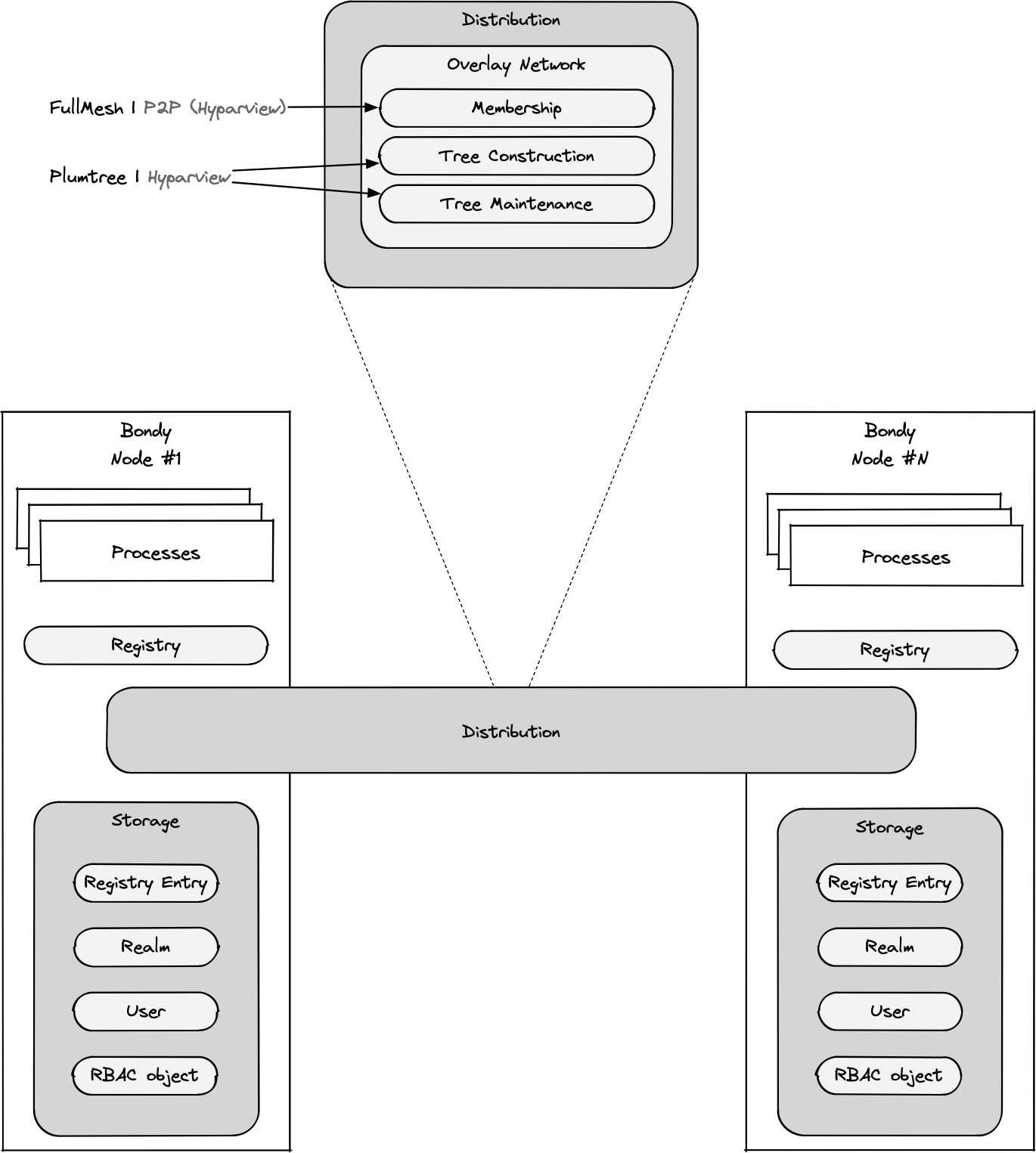
A Bondy node is three layers: the router that speaks WAMP and HTTP to clients, a storage and replication layer that gives every subsystem a replicated, convergent place to keep state, and clustering that connects nodes into a mesh with no leader.

The Router
The router (bondy_router) implements the WAMP dealer (routed RPC) and broker (Pub/Sub) roles, the HTTP API Gateway, and the Admin API. Routing a call or an event whose destination is on another node is a cluster-routing decision — the router doesn't hold that state itself; it asks the Registry Routing (RIB), which tracks which nodes can serve which procedures and topics without requiring every node to hold a copy of every registration.
Storage and Replication
Every stateful subsystem — security (users, groups, sources, grants), realms, the API gateway, tickets and tokens — reads and writes through bondy_db: a sharded key/value facade where each table declares its own CRDT semantics (last-writer-wins registers, add-wins sets and maps, counters, and more). Underneath, bondy_oplog gives each shard a write-ahead log for durability, built on the bondy_log append-only log, and a Merkle Search Tree (MST) for anti-entropy: peers compare tree root hashes and exchange only the pages that actually differ, rather than comparing every key on every sync. Durable tables persist to a leveled LSM-tree store with an ETS point-read cache; the registry and other latency-critical state are fully in-memory.
Every replicated write carries a Hybrid Logical Clock (HLC) timestamp, giving a leaderless, causally-meaningful ordering without relying on synchronized wall clocks. Deleting a value is itself a replicated operation — it must leave a tombstone, since the tombstone is what rejects a late-arriving concurrent write — and physically reclaiming that tombstone's space is licensed only once every node has provably seen it. See Deletion and Reclamation for why that distinction matters and how it's made safe.
Because convergence never blocks on a majority round-trip, an isolated node can still serve reads and writes from what it has. The one place this needs a safeguard is authentication: a node whose view of security state is provably stale beyond a configurable bound refuses to authenticate against it rather than risk deciding on out-of-date grants. See the Data Storage & Active Anti-entropy Configuration Reference for that fence, the sync protocol, and sharding and placement.
Clustering
Nodes connect over Partisan, a high-performance Distributed Erlang replacement supporting multiple network topologies and larger clusters than standard Distributed Erlang. Partisan carries Bondy's traffic on separate channels. Calls and events routed between nodes travel on wamp_relay. Anti-entropy sync sessions travel on a dedicated bondy_aae channel, so that state repair does not compete with WAMP traffic. The wamp_relay, data, control_plane and default channels each have their own connection parallelism and compression settings; see the Cluster Configuration Reference. See Clustering for cluster formation, peer discovery, and the security of the peer plane: a node with peer discovery enabled refuses to start unless the peer plane uses TLS with certificate verification, because an insecure peer plane can leak replicated credentials and signing keys.
Consistency in Practice
Within that design, Bondy offers a few distinct consistency guarantees depending on what's being read:
- Eventual consistency — the default for cluster-wide state: if no new updates arrive, every replica converges to the same value.
- Causal consistency — if node A has observed node B's update, a subsequent read on A never returns a value older than what A has already seen.
- Session consistency (read-your-writes) — for the duration of a session, a client always observes the values it has itself written, on the node it is connected to.
See also
- Clustering — cluster formation, peer discovery, and replication in depth.
- Registry Routing (RIB) — how calls and events cross nodes without full-mesh replication.
- Deletion and Reclamation — the model behind safely reclaiming deleted data.
- Data Storage & Active Anti-entropy configuration reference.