
Understanding Load Regulation and Rate Limiting
A router fails under pressure in two different ways, and they need two different answers.
The first is overload: legitimate work arrives faster than this node can perform it. Nothing here is abusive — the clients are well-behaved and every request deserves an answer — but the node cannot deliver one in useful time. Left alone, the node accepts everything and delivers nothing on time: work that costs microseconds of CPU takes seconds of wall clock because the process doing it waits behind everything else for a scheduler. Latency degrades for every client at once, including the ones already connected and working.
The second is abuse: a single source sends far more than its fair share — a reconnect storm, a credential-stuffing run, a runaway publisher loop. The node may be nowhere near saturation. The problem is the distribution of the load, not its total.
Bondy answers the first with load regulation and the second with rate limiting. This guide explains both: what each mechanism measures, when it acts, what a client observes when it does, and what you can watch to tell whether it is working.
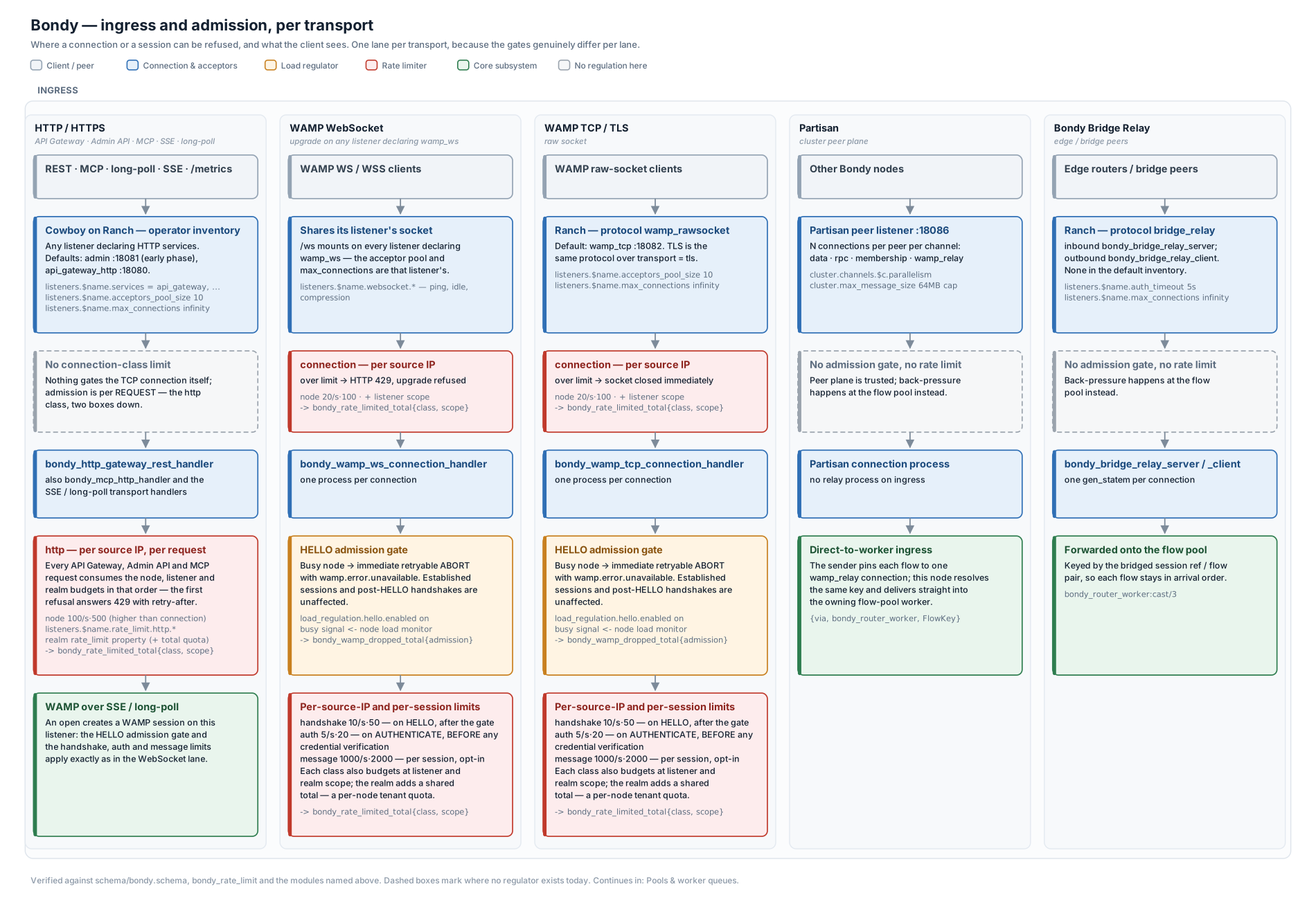
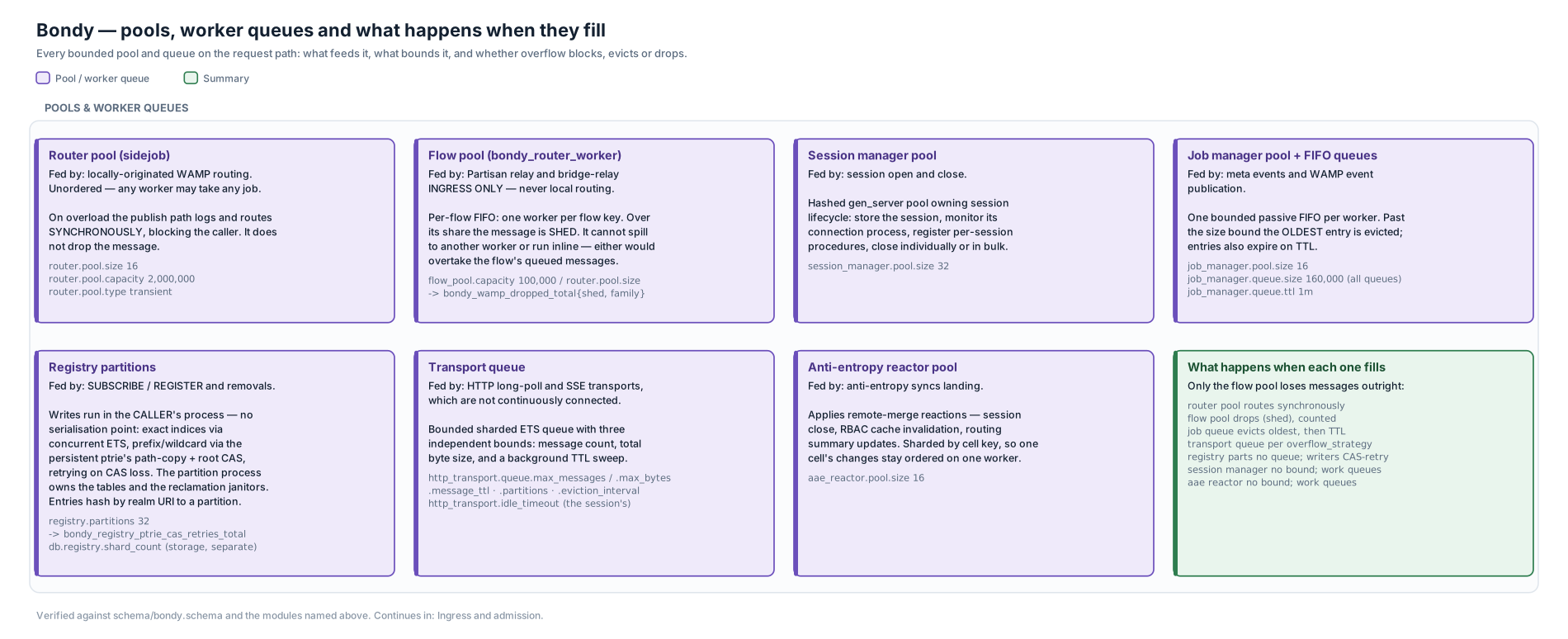
Two diagrams accompany it: the ingress lanes below and the pools and queues further down; the closing regulators at a glance then collects every regulator into two tables. The diagrams are dense by design, so each one zooms in place — use the controls, double-click, or Ctrl/⌘ and scroll, and drag to pan. They stay sharp at any zoom.
Start with ingress. Each transport gets its own lane because the gates genuinely differ per lane — and the dashed boxes are worth noting early: they mark the spots where no regulator sits, which on the cluster peer planes is deliberate.
Two questions, two mechanisms
Every regulator in Bondy answers one of two questions.
Load regulation asks "is this node able to do more work right now?" The answer is about the node, and it is the same answer for every client. When it is "no", the cheapest correct response is to refuse new work immediately and keep serving the work already accepted.
Rate limiting asks "has this particular source had its share?" The answer is about one source IP or one session and says nothing about the node's health. A rate limit trips at exactly the same threshold on an idle node as on a saturated one — that is the point.
The two compose. A node can be healthy and still throttle an abusive client; it can be overloaded and refuse a client who has done nothing wrong. Neither mechanism subsumes the other, and reaching for the wrong one produces bad behaviour: rate limits tuned to protect the node have to be set so low they punish legitimate bursts, and load regulation cannot see that one client out of ten thousand is responsible for the pressure.
The node load signal
Load regulation needs a number that means "this node is behind". CPU utilisation is the obvious candidate and the wrong one: a node at 100% CPU that is keeping up is healthy, and a node at 60% CPU whose work is stuck behind a few long-running processes is not.
The signal Bondy uses instead is the run queue — the count of processes that are ready to run and waiting for a scheduler. This measures scheduling delay directly, which is the thing that actually degrades: a session open is cheap in CPU terms, and it takes seconds anyway when its process sits behind several thousand others.
Two subsystems sample this signal, in two different shapes, because they are asking different questions.
The node monitor: a binary busy state
The load monitor samples the runtime's total run queue length every load_regulation.load_monitor.sample_interval and exposes a single binary status: busy or normal.
The thresholds are expressed as multiples of the online scheduler count rather than absolute queue lengths, so one configuration is portable across machine sizes. The node becomes busy when the sampled queue reaches load_regulation.load_monitor.run_queue_high_watermark × schedulers, meaning roughly that many runnable processes ahead of any newly runnable one on every scheduler. It returns to normal only when the queue falls to load_regulation.load_monitor.run_queue_low_watermark × schedulers.
The gap between the two watermarks is deliberate. Without it the status would flap on every sample at the boundary, and each flip would change the node's admission behaviour — clients would see a node that accepts and refuses alternately for as long as load hovered near the threshold. Widening the gap makes the node slower to recover but steadier; narrowing it does the reverse.
Reading the status is a single lock-free atomic read, so admission gates can consult it per request without a process hop.
The anti-entropy signal: a smoothed ratio
Anti-entropy asks a softer question — "is now a good moment for background work?" — so it uses a softer signal: run queue length divided by the online scheduler count, giving the average number of ready processes per scheduler, then smoothed with an exponentially weighted moving average across ticks.
A ratio rather than a count, because the comparison is against an intuitive figure: the default threshold of 2.0 means that, on average, two ready processes wait behind each scheduler. Only normal schedulers count, so disk-bound dirty work, which yielding anti-entropy would not relieve, does not move the ratio. Smoothed rather than raw, because deferring background reconciliation on a single unlucky sample would make convergence latency jittery for no benefit — a momentary spike is not a reason to stop syncing.
Refusing work at the door
The cheapest work is work never accepted. When the node is busy, Bondy refuses new sessions at the earliest point it can.
With load_regulation.hello.enabled on (the default), a HELLO arriving while the node is in the busy state is answered immediately with an ABORT carrying wamp.error.unavailable. The cost to the node is a parse and an encoded reply.
The alternative — accepting the session — is far more expensive, and worse for the client. Establishing a session means holding a socket, allocating session state, and running authentication, all of it stretched by the same scheduling delay that made the node busy. The likely outcome is a client-side timeout after the node has paid for all of it, with the session state to tear down afterwards.
Two properties make this safe to leave on:
- The refusal is retryable.
wamp.error.unavailabletells a well-behaved client to back off and try again, possibly reaching a different node through its load balancer. It is an availability condition, not a client error, and clients should not treat it as a permanent failure. - It applies only at the door. Sessions already established are unaffected, and so are handshakes already past
HELLO. The gate protects the latency of admitted sessions by declining to share the overload with them. A node under pressure keeps its existing clients working rather than degrading everyone equally.
Each refusal increments bondy_wamp_dropped_total with reason="admission" and family="hello".
Shedding work that cannot wait
Refusal at the door is not always available. Some work is already inside the router when the pressure appears, and for one class of it, queuing is not an option.
That class is ingress from elsewhere in the cluster: messages arriving from a peer node's relay, and from a bridge relay. These arrive in an order that already means something — the sending side pins each flow (a source/destination session pair) to one connection on the wire, so the messages of a flow reach this node in the order they were sent. Preserving that order locally means dispatching every message of a flow to the same worker in the flow pool, so they execute in arrival order.
That guarantee is what makes the queue bound unusual. When a worker's queue is full, the router cannot spill the message to another worker — it would overtake the messages already queued for that flow — and cannot execute it inline, for the same reason. The only order-preserving option left is to drop it. WAMP delivery here is at-most-once, so a drop is the protocol behaving as specified rather than a failure.
load_regulation.router.flow_pool.capacity is the total message budget across the pool; each worker's share is that value divided by load_regulation.router.pool.size. Over its share, the worker sheds.
This bound is deliberately far smaller than load_regulation.router.pool.capacity, which governs the separate, unordered router pool used for locally-originated routing. An ordered lane cannot overflow to a neighbour, so a large bound buys memory pressure rather than throughput — the messages queue up, the flow falls further behind, and the eventual drop happens anyway with more RAM consumed on the way.
Sheds increment bondy_wamp_dropped_total with reason="shed" and a family label distinguishing relay from bridge-relay ingress.
The pools at a glance
The flow pool is one of seven bounded pools and queues on the request path. They differ in what feeds them, what bounds them, and — the part worth knowing before an incident — what each does when it fills. Only the flow pool loses messages outright.
Reading logs during a shed storm
The log line accompanying a shed is itself rate-limited, so a shed storm cannot turn into a log storm. Expect fewer log lines than the counter suggests — trust the counter.
Keeping background work subordinate
Anti-entropy reconciles data between nodes. It is necessary, and it is never more important than routing. Three mechanisms keep it in its place, and they bound different things.
Concurrency — db.aae.max_concurrency caps how many sync sessions run at once. This governs speed and fairness, not memory: the per-round page batch is db.aae.max_pages_in_flight divided by this value, so raising concurrency shrinks each session's batch and leaves the node-wide page budget unchanged. More concurrency means more shards make progress at once, each more slowly, so no shard starves behind a single serial sync. Setting it to 1 serialises anti-entropy, except for the shards that back the authentication freshness fence, which bypass the cap.
Memory — db.aae.max_pages_in_flight is the node-wide budget, in pages, for reconciliation in flight at any instant. This is the lever for peak memory, and it does not depend on dataset size or concurrency. Each session of a fence-backing shard bypasses the concurrency cap and adds one batch above the budget. Larger syncs faster and peaks higher; smaller is gentler and slower.
Time — the other two bound anti-entropy in aggregate; neither stops it from competing with a routing spike happening right now. db.aae.live_sync handles the steady state: a shard whose data has settled has nothing to pull, so its poll interval backs off geometrically up to db.aae.live_sync.max and resets to the tick cadence the moment its data moves again. Because propagation is pull-only, that cap is also the steady-state convergence latency for a quiescent shard — set it below the convergence bound you need.
db.aae.load_adaptive handles the spike: while the smoothed load ratio sits at or above db.aae.load_run_queue_threshold, the scheduler skips bootstrap transfers and the live syncs of shards that do not back the fence for that tick. The scheduler does not stop sessions already running, and it dispatches the deferred shards on the next tick below the threshold. The throttle therefore delays convergence; it does not change what converges. It is off by default because the concurrency cap and the live-sync backoff already keep anti-entropy subordinate; turn it on where routing latency is sensitive to background pressure.
Authentication is never throttled into an outage
Both throttles, and the concurrency cap, exempt the shards that back the authentication freshness fence. Those shards start a sync on every tick, so throttling does not delay the confirmation of freshness that the fence reads.
The work anti-entropy triggers when a sync lands — session close, RBAC cache invalidation, routing summary updates — runs on its own pool, sized by load_regulation.aae_reactor.pool.size. Events are sharded by cell key, so a given cell's changes always run on the same worker and stay ordered. Raising this helps only when reactions for many distinct cells are in flight at once.
The regulators at a glance
That completes the set. Two tables collect it: the run-queue signal in its two shapes, and then every regulator with what it reads, what it does, and the counter that tells you it is engaging.
The first makes explicit something easy to miss — the node monitor and anti-entropy sample the run queue separately, in different shapes, and neither feeds the other:
| Node load monitor | Anti-entropy scheduler | |
|---|---|---|
| Reads | Total run queue length, raw, every 100ms | Run queue ÷ online schedulers |
| Compared against | run_queue_high_watermark (8) × schedulers; back to normal at run_queue_low_watermark (4) × schedulers | db.aae.load_run_queue_threshold (2.0), as an EWMA-smoothed ratio across ticks |
| Output | One binary status: busy / normal | Throttle this tick, or not |
| Consumer | The HELLO admission gate | The anti-entropy scheduler, when db.aae.load_adaptive is on |
The hard threshold answers an admission question that must not flap; the smoothed ratio answers a "good moment for background work?" question that must not overreact to one sample.
| Regulator | Protects | Signal it reads | When it acts | Configuration (default) | Watch |
|---|---|---|---|---|---|
HELLO admission gate | latency of admitted sessions | node monitor busy state | immediate retryable ABORT (wamp.error.unavailable); established sessions unaffected | load_regulation.hello.enabled (on) | bondy_wamp_dropped_total{reason="admission"} |
| Flow-pool bound | memory and ordering on cluster ingress | a worker's queue vs its share of the budget | the message is shed (at-most-once delivery) | load_regulation.router.flow_pool.capacity (100,000) | bondy_wamp_dropped_total{reason="shed"} |
| Anti-entropy concurrency cap | routing fairness | count of running sync sessions | further syncs are skipped until a later tick; per-round batch = pages ÷ concurrency; fence-backing shards exempt | db.aae.max_concurrency (3) | — |
| Anti-entropy page budget | peak memory | reconciliation pages in flight | batches shrink; the budget does not depend on dataset size | db.aae.max_pages_in_flight (2048) | — |
| Live-sync backoff | steady-state background cost | whether the shard's data moved | poll interval backs off geometrically to db.aae.live_sync.max (5s), resets on change | db.aae.live_sync (on) | — |
| Load-adaptive throttle | routing during a spike | the smoothed run-queue ratio | that tick's bootstraps and non-fence live syncs are skipped; running syncs continue | db.aae.load_adaptive (off) | bondy_oplog_sync_scheduler_yielding |
| Rate limiting — five classes, three scopes | fair share per source IP / session / tenant | token buckets, consumed node → listener → realm | 429 / ABORT / ERROR / silent drop, per class — next section | security.rate_limit.* · listeners.$name.rate_limit.* · the realm rate_limit property | bondy_rate_limited_total{class, scope} |
Callee admission (bondy_connect_sdk) | the callee's handler pool | in-flight invocation count, plus an optional token bucket | backpressure ERROR instead of running the handler | handler.max_concurrency · handler.rate (client-side, not bondy.conf) | — |
Every row fails open, so a missing denial counter is not proof the regulator is configured — it may simply never have been needed, or never have been on.
Rate limiting inbound traffic
Out of the box nothing is throttled. Budgets exist at three scopes — node, listener and realm, covered below — and none ships enabled: the node scope's master switch, security.rate_limit.enabled, is off (leaving the check a single map read on the common path), and a listener or realm budget exists only where an operator configures one.
Five classes apply token buckets at five points in a connection's life. Each class has a rate in tokens per second (the steady-state allowance) and a capacity (the burst a client may spend at once before being held to the rate).
| Class | Keyed by | Applied at | Client sees |
|---|---|---|---|
connection | source IP | transport handler, before any per-connection work | TCP: socket closed. WebSocket: HTTP 429 |
handshake | source IP | HELLO, after the load admission gate | ABORT with wamp.error.unavailable |
auth | source IP | AUTHENTICATE, before credential verification | ABORT with wamp.error.unavailable |
http | source IP | every HTTP request — API Gateway, Admin API and MCP endpoints | HTTP 429 with a retry-after header |
message | session | CALL / PUBLISH / SUBSCRIBE / REGISTER | ERROR with wamp.error.unavailable, or a silent drop |
The auth limit applies before verification, which is the point: verification is the expensive step a credential-stuffing run is trying to make you perform.
The message class sits on the per-message hot path, so its node-scope budget has its own opt-in flag, security.rate_limit.message.enabled, on top of the master switch. Its bucket chain — one bucket per scope configured for the class — is resolved once at session open and held in the connection's state, so the per-message cost is a field read plus an atomic operation per configured scope, never a configuration lookup. This applies on every transport that carries a WAMP session: WebSocket, raw socket, SSE and long-poll alike. A throttled message that expects a reply gets a WAMP ERROR; an unacknowledged PUBLISH expects no reply, so it is dropped silently, since sending an error to a sender that is not listening would be a protocol violation.
The abort and error messages are deliberately generic: they say the client should slow down and retry, and nothing about which limit tripped or whether the credentials were valid. A pre-authentication signal that varied by cause would be an enumeration oracle.
Denials increment bondy_rate_limited_total, labelled by class and scope.
Scopes: node, listener, realm
Every class can be budgeted at up to three scopes, and a request is admitted only when all of them admit it:
- Node — the
security.rate_limit.*keys: budgets shared by every listener and realm on the node. This is where the master switch lives. - Listener — the
listeners.$name.rate_limit.*keys: the same classes, budgeted per listener, so an Internet-facing listener can be held to a tighter budget than an internal one. - Realm — the realm's own
rate_limitproperty, set through the realm admin APIs or the security configuration file and replicated with the realm. It covers the classes a realm-addressed request reaches —auth,httpandmessage(connectionandhandshakefire before any realm is named) — and is the only scope with two budget kinds:per_caller(a bucket per source IP or session, like the other scopes) andtotal, one bucket shared by all of the realm's callers — a tenant quota.
The scopes are consumed coarse to fine — node, then listener, then the realm's per_caller, then its total — and each configured scope consumes one token per request; the first refusal answers, and tokens already consumed at outer scopes are not returned. The composition can therefore only narrow: no listener or realm setting can grant traffic the node's own budget refuses, which is what keeps a node-wide bound like the per-IP auth credential-guessing budget meaningful whatever else is configured.
Each scope is enabled independently. The node scope has its master switch; a listener or realm class budget is in force simply by being configured, whether or not node-scope limiting is on.
The realm total is a per-node quota
Buckets are node-local. A realm total of N tokens per second bounds each node separately, so a cluster of three nodes admits up to 3×N per second for that realm. Size it per node, or use per_caller budgets when you need a bound that does not scale with the cluster.
The denial metric's scope label says which scope refused: node, listener, realm (a caller over its own realm budget) or realm_total (the realm's shared quota exhausted) — so a hot caller and an exhausted tenant quota are distinguishable at a glance.
Checking is cheap — refusing is not
Do not size budgets down out of concern for the cost of the checks themselves. With nothing configured the per-message check is a single field read; each configured scope adds one lock-free atomic operation per message, and the realm total one shared-table consult — all of it orders of magnitude below the cost of routing the message, with no measurable effect on message throughput or latency at any scope combination. The connection, handshake and auth classes cost one keyed-table consult per scope per attempt, a similarly negligible fraction of establishing a session. The expensive outcome of rate limiting is a budget sized too tight for legitimate traffic: refusals, retries and reconnect storms cost far more than the checks ever will. Size budgets for abuse, leave them enabled, and watch bondy_rate_limited_total rather than pre-emptively loosening.
Buckets and keyspace
Source IP is an unbounded, transient dimension: a flood from a churning set of addresses would mint a bucket per address and never release one. Bondy's keyed limiter creates a bucket on first use and a background sweep deletes buckets idle beyond a TTL, so the keyspace cannot grow without bound. The hot path stays a lock-free table lookup plus an atomic check. Per-session message buckets have a definite owner and are freed at session teardown instead — except the realm total, which is shared by every session on the realm and therefore lives in the keyed table with the per-IP buckets, swept by idleness like them.
Source IP behind a proxy
Every per-IP limit throttles a source IP collectively. Clients behind a shared NAT or a reverse proxy that does not forward the original address all present one IP to Bondy and share one bucket, so limits that look generous per client can be strict in aggregate. Configure trusted proxies so Bondy resolves the real client address, and keep the limits generous until you have confirmed clients present distinct addresses.
Regulating callee invocations
The mechanisms above protect the router. A callee has the opposite problem: it is one process pool serving invocations the router sends it, and a burst can overwhelm the handler rather than the router.
Connections built with bondy_connect_sdk regulate invocation admission per connection, through two independent limits: a hard in-flight cap (max_concurrency, where 0 means unlimited) counting invocations currently being serviced, and an optional token bucket for the rate. Both live in the connection's handler configuration rather than bondy.conf, because they belong to the client, not the node.
When admission is denied the connection replies to the router with a backpressure ERROR instead of running the handler. The distinction matters: this governs whether an invocation is started, while the handler supervisor governs how it runs.
Failing open
Every regulator described here fails open. If the load monitor is not running, the node reads as normal and admits. If the rate limiter's table is unavailable, requests are allowed. If a per-session bucket cannot be created, that session runs unthrottled and the node logs a warning.
This is a deliberate ordering of risks. A regulator that fails closed converts its own bug or startup race into a total outage — the node refuses everything because the thing that decides what to refuse is broken. Failing open degrades to the behaviour Bondy had before the regulator existed, which is a known and survivable state. Availability of the router outranks the accuracy of its regulation.
Absence of throttling is not proof of throttling
Because every regulator fails open, seeing no denials does not confirm your limits are active. Confirm with the counters below.
What to watch
Four signals tell you whether regulation is engaging, and they mean different things.
bondy_wamp_dropped_total{reason="admission",family="hello"}— sessions refused because the node was busy. A nonzero rate means the node is at its session-establishment ceiling. Sustained, it means you need more nodes or a higher watermark, not a bigger timeout.bondy_wamp_dropped_total{reason="shed"}— messages dropped to preserve flow ordering, labelled by family. This is data loss by design, and it is the signal that a flow is producing faster than its destination consumes.bondy_rate_limited_total{class, scope}— denials per class and scope. Thescopelabel names the budget that refused —node,listener,realm(one hot caller) orrealm_total(a tenant quota exhausted). Read alongside the node's load: denials on a healthy node point at one misbehaving source, while denials across every class at once usually mean the limits are simply too tight for your topology.- Run queue length — the input to everything above, and the leading indicator. It rises before the refusals start.
See the metrics reference for the full set, and Monitoring with Prometheus & Grafana for the dashboards that plot them.
Choosing values
The defaults are sized for a node doing real work and are safe to run unchanged. When you do change them:
Watermarks are factors, not counts. Raising the high watermark makes the node tolerate deeper queues before refusing sessions — more sessions admitted, each establishing more slowly. Lower it if establishment latency matters more than admission volume. Keep the low watermark meaningfully below the high one; a narrow gap trades steadiness for recovery speed.
Flow pool capacity is not throughput. Raising it lets a slow flow queue more before shedding, which helps a genuinely bursty consumer and does nothing for a consumer that is persistently slower than its producer — for that one it only delays the drop and holds the memory meanwhile.
Anti-entropy trades convergence latency for headroom. Lowering db.aae.max_pages_in_flight cuts peak memory and slows sync. db.aae.live_sync.max is a convergence bound, so treat it as an SLA figure rather than a tuning knob.
Rate limits are topology-dependent. The right values depend entirely on how many clients share a source IP. Enable the limits in a staging environment first, watch bondy_rate_limited_total, and raise them until legitimate traffic stops being denied — starting from the defaults on a NAT-heavy deployment will deny real clients.